On Architectural Drift
AI can write the code faster than any team can fully account for it. Each accepted change looks fine on its own, but architectural drift, and the understanding debt underneath it, compounds quietly until it doesn't.
Lindsay Britt
7 min read
AI is making more development and modernization work practical than it used to be. Projects that would once have been too expensive or too risky to justify are now within reach: a decade-old platform can be extended instead of replaced, a migration can run in months instead of years, a backlog of deferred work can finally get worked through. That is a real opportunity, not a hypothetical one.
What is harder to see is whether an organization can account for what it is accepting along the way. Throughput is easy to measure and easy to report upward. Whether a team still understands the consequences of the changes it approves is not, and the two can move in opposite directions for a long time before anyone notices which one is losing ground.
Deterministic AI code governance means verifying AI-generated and AI-modified code against a fixed, source-derived model of what a system is supposed to do, rather than trusting that a generated change preserves the system's design intent. Probabilistic code generation produces plausible-looking output with no persistent memory of prior architectural decisions behind it. Deterministic governance gives an organization a repeatable way to check a proposed change against how the system actually works, not only whether it compiles and passes its tests.
That distinction sits underneath everything below.
What a Single Accepted Change Actually Requires
Consider what happens inside one accepted change. A team modernizing or extending a production system asks an AI tool to implement a new requirement. The tool delivers something that meets the immediate spec and passes its tests, real progress, not a false positive. But the same change also relocates a shared calculation, adds a dependency nobody requested, or duplicates a rule that used to live in exactly one place. Each of those side effects can be entirely correct on its own terms. The open question is not whether the change works. It is whether it was authorized, and whether whatever it touched still behaves the way the rest of the system depends on it behaving. Answering that takes evidence, not confidence, and most teams currently have the second without the first.
Architectural Drift Is the Symptom. Understanding Debt Is What Is Underneath It.
None of this shows up as an incident. It shows up, if it shows up at all, as architectural drift: a system that keeps passing every test while quietly moving away from how it was designed to work. Drift is the visible symptom. What is actually accumulating underneath it is understanding debt, a growing gap between what the system does and what the organization can confidently account for.
Understanding debt is a different flavor of technical debt than the kind most engineering leaders already have a mental model for. Classic technical debt accumulates in code: duplicated logic, brittle dependencies, modules nobody wants to touch. This accumulates in understanding. The code can look clean, pass every test, and still represent a system that no one, human or model, can fully explain.
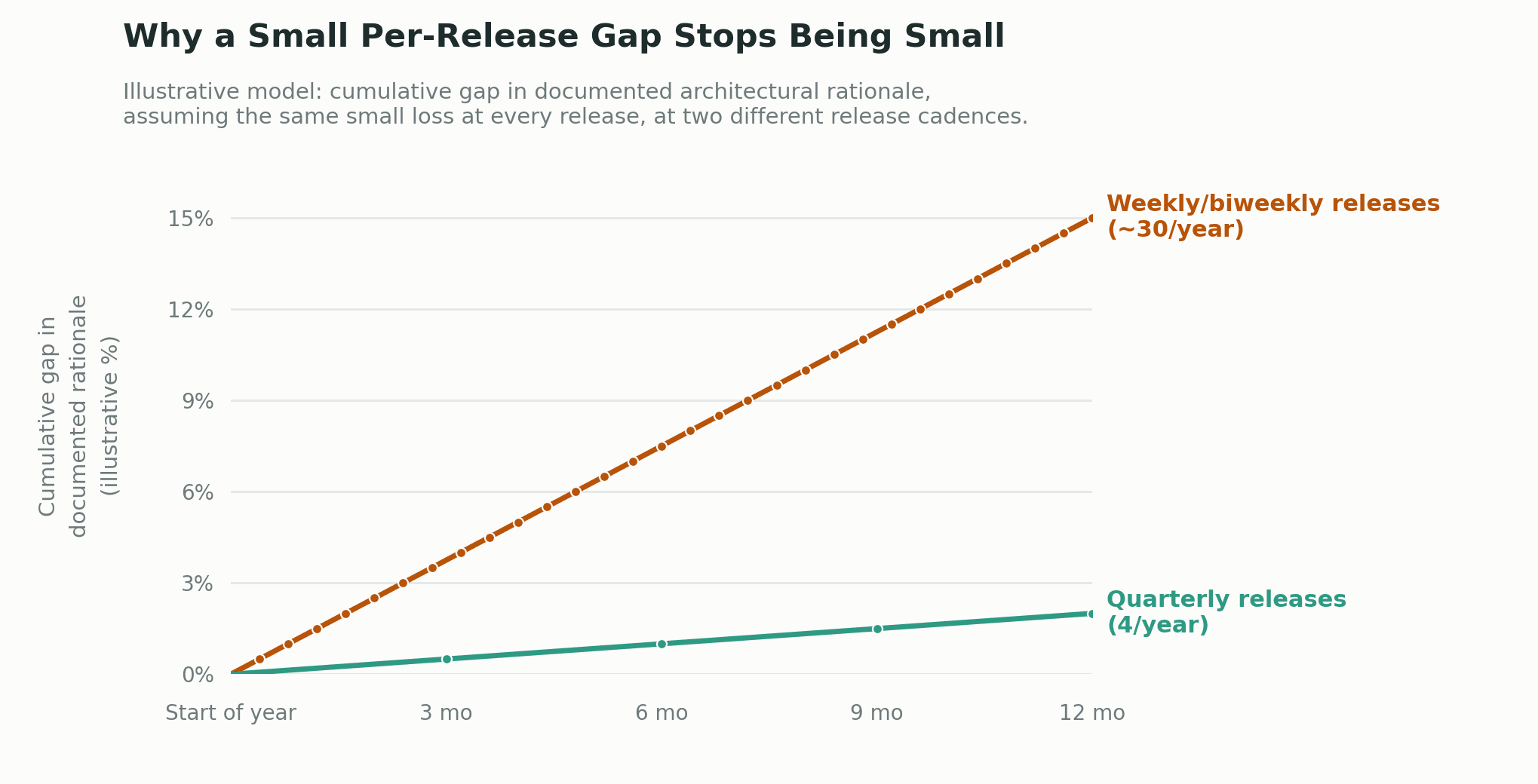
This is not a new phenomenon, and it is not an inevitable crisis. Every engineering organization has always carried some gap between its documentation and its code. What has changed is the rate at which AI-assisted teams can now approve changes, which means that ordinary, everyday gap compounds faster than most review processes were built to catch. Consider the arithmetic, even loosely. If an organization loses some small share of documented rationale with every release, that loss is trivial in isolation. But release cadence has changed: many AI-assisted engineering organizations now ship changes weekly or biweekly instead of quarterly, and a small, steady loss compounded across dozens of releases a year stops being trivial. The consequence is not one dramatic failure. It is that each subsequent change becomes harder to assess, each review takes longer to reach real confidence, and maintenance costs climb well before anyone can point to a specific incident that caused it.
That shift is visible at industry scale, not just inside individual teams. A 2026 global survey of 2,350 developers, CISOs, and AppSec managers found that as AI takes over more of the actual writing, developers are moving from authors of code to editors of it, with human-written code now the exception rather than the rule.1 The survey's own conclusion lands on nearly the same point: that shift is "reshaping the assumptions [software] was built upon: visibility, ownership, accountability and control."
What a Sound Acceptance Decision Requires
A sound acceptance decision needs three things: a source-derived baseline of what the system actually implements today, the requirements the proposed change was authorized against, and evidence connecting the two. With that in place, four questions become answerable instead of assumed. What changed? Was it authorized? What was required to remain intact, and did it? What is still unverified?
That baseline cannot come from asking a model to reconstruct the system's intent from the code alone. A published benchmark on repository-level AI modernization found that agent pass rates fall off sharply as codebase size increases, with the decline steepest well before reaching the size of a typical enterprise system.2 The tools most likely to be trusted with that reconstruction are least reliable at exactly the scale where enterprise systems actually live.
That finding is usually read as a warning about code that does not work. Read it instead as a warning about code that looks like it works. Passing a test suite answers a narrower question than the one that actually matters: whether the person, or the model, that changed the system can explain why it is now shaped the way it is.
Tests, code review, regression harnesses, and AI context tools all contribute pieces of this picture, and none of them are being replaced here. What is missing is a continuing record that ties their findings back to a stable account of the system's actual behavior, updated as the system changes rather than reconstructed from memory every time someone needs it. That record has to track what the system currently does, which is different from what it was originally designed to do or why a decision was made five years ago. Implemented behavior is what a change gets checked against. Design intent and historical rationale are valuable context, not a substitute for it.
The Job Before the Name
The job, before it needs a name, is this: evaluate every proposed change against a versioned baseline and a set of approved rules, produce findings that are repeatable and traceable back to specific source, stay within a clearly defined scope, and keep whatever remains unresolved visible rather than resolving it quietly. When a person decides to accept a flagged, unresolved issue anyway, that decision and its basis get recorded. The system does not get to claim it verified something it did not.
That job has a name: deterministic AI code governance, doing the work of a governor, independent of whatever generated the change, sourced from the platform's own code, and explicit about what it can and cannot verify.
This is the same foundation Holonic has built through years of modernization work. Accounting for what a legacy system actually does, precisely enough to know a replacement is equivalent to it, is fundamental to every migration we run. The idea behind CodeIntent is that this same foundation does not have to end when the migration does. It can keep answering the same questions for every change that follows, whether that change comes from a person or an agent. CodeIntent Studio provides that baseline and evidence trail today; broader autonomous proposal and enforcement is on our roadmap, not a capability we are claiming now.
The Case for Moving Faster, Not Slower
None of this is an argument for slowing down. AI is making more modernization and development work possible than organizations could previously justify, and that opportunity is real. The goal is for enterprises to absorb more software change with clearer evidence behind every decision to accept it, not less change with more hesitation.
The uncomfortable part of this argument is that the damage is invisible by design. No team wakes up one morning having lost its grip on a platform. It arrives there gradually, a release at a time, and finds out only when something significant needs to change and turns out to be far harder than anyone expected. The better time to build that evidence is now, while the answer is still something you can act on rather than something you discover the hard way.
CodeIntent gives teams that evidence: a deterministic, source-derived account of what a system does, checked against every proposed change, so the answer to whether something is safe to accept does not depend on how thoroughly anyone happened to check that day.
LLMs propose. Holonic verifies.
See CodeIntent Studio to look at what a deterministic model of your own platform's architecture would actually show.
Share this post
Stay in the loop
Get new writing on deterministic modernization, evidence, and governed AI.
Related articles

COBOL to Java Migration Testing: A Practical Checklist for Verifying Behavior
Months of matching parallel runs can still miss a path that never ran. This guide covers the COBOL baseline, the COBOL-to-Java traps to test, what acceptance evidence should include, and a 10-point exit-criteria checklist to write into your acceptance terms.

How to Detect Unintended Behavior Changes in AI-Generated Code
A one-line code change can alter three business workflows while every test stays green. Here's how to compare behavior against an accepted baseline and make each acceptance decision inspectable.

Why COBOL to Java Migrations Stall at Sign-Off, and How Bounded Verification Fixes It
AI can generate COBOL to Java migrations fast, but production sign-off still requires a human reviewer's certification. This piece explains why unbounded review breaks down at scale, and how a bounded, source-traced evidence trail makes sign-off possible again.
Checkmarx, "The Future of Application Security in the Era of AI," 2026 Global Report (Censuswide survey of 2,350 developers, CISOs, and AppSec Managers, fielded March 2026).
RepoMod-Bench (2026), arxiv.org/abs/2602.22518
HOLONIC
The deterministic evidence layer underneath legacy modernization and the agentic enterprise.
© 2026 Holonic Technologies, Inc. · Atlanta, GA · Tucson, AZ
CodeIntent® is a registered trademark of Holonic Technologies.