Deterministic AI Code Modernization
LLMs can generate legacy code migrations fast, but they can't demonstrate what they changed or account for what broke along the way. Here's why sampling and coverage reports fall short, and what deterministic verification actually requires.
Lindsay Britt
6 min read
The Core Problem: Accounting for Change
During a recent modernization pilot, a prospect used a large language model to translate a legacy codebase into a modern target language. The output looked clean, the model's own review flagged nothing, and functional testing still found five edge cases the model had missed entirely.
The team asked the model to fix those five errors, and the next build resolved them. Retesting surfaced new regressions in places nobody had touched intentionally. The model kept no record of what its fix had altered, so nobody could trace which dependencies had shifted or say with confidence the rest of the system still behaved as it had before.
That outcome is less a model-quality problem than a missing accounting problem: the team wasn't struggling to generate code quickly, they were struggling to prove what the code did and account for what changed once it stopped doing that. In a regulated environment, "the model said it was fine" is not an answer an examiner or a board will accept, which is exactly what puts LLM code hallucination risk mitigation on a CISO's agenda before a migration reaches production.
What is deterministic AI code modernization? Deterministic AI code modernization replaces prompt-based, probabilistic code generation with a deterministic, evidence-based transformation process. Instead of guessing what legacy code should become, a deterministic verification platform derives a semantic intent layer from the source system's actual behavior and demonstrates, line by line, equivalence between the modernized code and its source counterpart across the full input and state space. The output is a code conversion audit trail an auditor can rely on, not a coverage estimate.
The Probabilistic Wall and the Legacy Code’s Hard 20 Percent Problem
Every correction a large language model makes is a fresh draw from the same probability distribution that produced the original errors, so fixing one line guarantees nothing about the surrounding logic, only that it hasn't been tested yet. Yann LeCun has described this as a structural property of autoregressive generation, not an occasional failure: "as output grows longer, the probability that the entire result is correct falls off exponentially, since every additional token carries its own independent chance of drifting outside the correct answer."
Published benchmark data confirms the pattern. RepoMod-Bench, a 2026 evaluation of repository-level AI modernization, found agent pass rates falling from 91.3 percent on codebases under 10,000 lines to 15.3 percent above 50,000, a 76-point drop. That's the legacy code's hard 20 percent problem in measured form: models get a project most of the way there quickly, then stall on the undocumented logic and edge cases where pass rates collapse, right in the size range this audience maintains. Scale is part of the appeal, but reviewing every line and proving every line correct are different claims, since a model judging line four million is still guessing, just at a larger scale that distributes the same compounding risk across more code.
Sampling Isn’t Proof: Building a Real Code Conversion Audit Trail
Most testing regimes were never built to answer the question modernization actually poses: does the new system behave exactly like the old one across every input, not just the ones scripted into a test case? Regulated industries push past simple sampling. Banking and insurance migrations commonly run full parallel processing, reconciling every historical transaction against both systems for months or years, a practice one practitioner described as continuing "until the existing run was beaten to the core with zero tolerance." That's genuine rigor, and an expensive way to buy confidence that still doesn't fully answer the question, since it proves the systems match on the transaction history available but says nothing about the edge case sitting one input combination outside years of parallel data.
Line-by-line demonstrated equivalence closes that gap by construction: evidence that every line performs the same transformation as its source counterpart, across the full input and state space, including edge cases nobody has hit yet.
Dimension | Standard Testing | Demonstrated Equivalence |
|---|---|---|
Coverage scope | Sample-based, only paths explicitly scripted | Exhaustive across the full input and state space |
Audit evidence | Pass/fail ratios, coverage percentages | Source-traceable proof artifacts, behavioral mapping |
Edge case handling | High risk of missing unscripted inputs | Accounts for the complete state space by construction |
Regulatory posture | Demonstrates due diligence via sampling | Demonstrates governed, source-traceable evidence |
Moving from the left column to the right changes the claim a team can make to a risk committee, from "we reconciled every known transaction over several years" to "we demonstrated equivalence across the full space of possible behavior, with every artifact dispositioned and zero left unexplained," the claim a zero-tolerance audit committee actually requires.
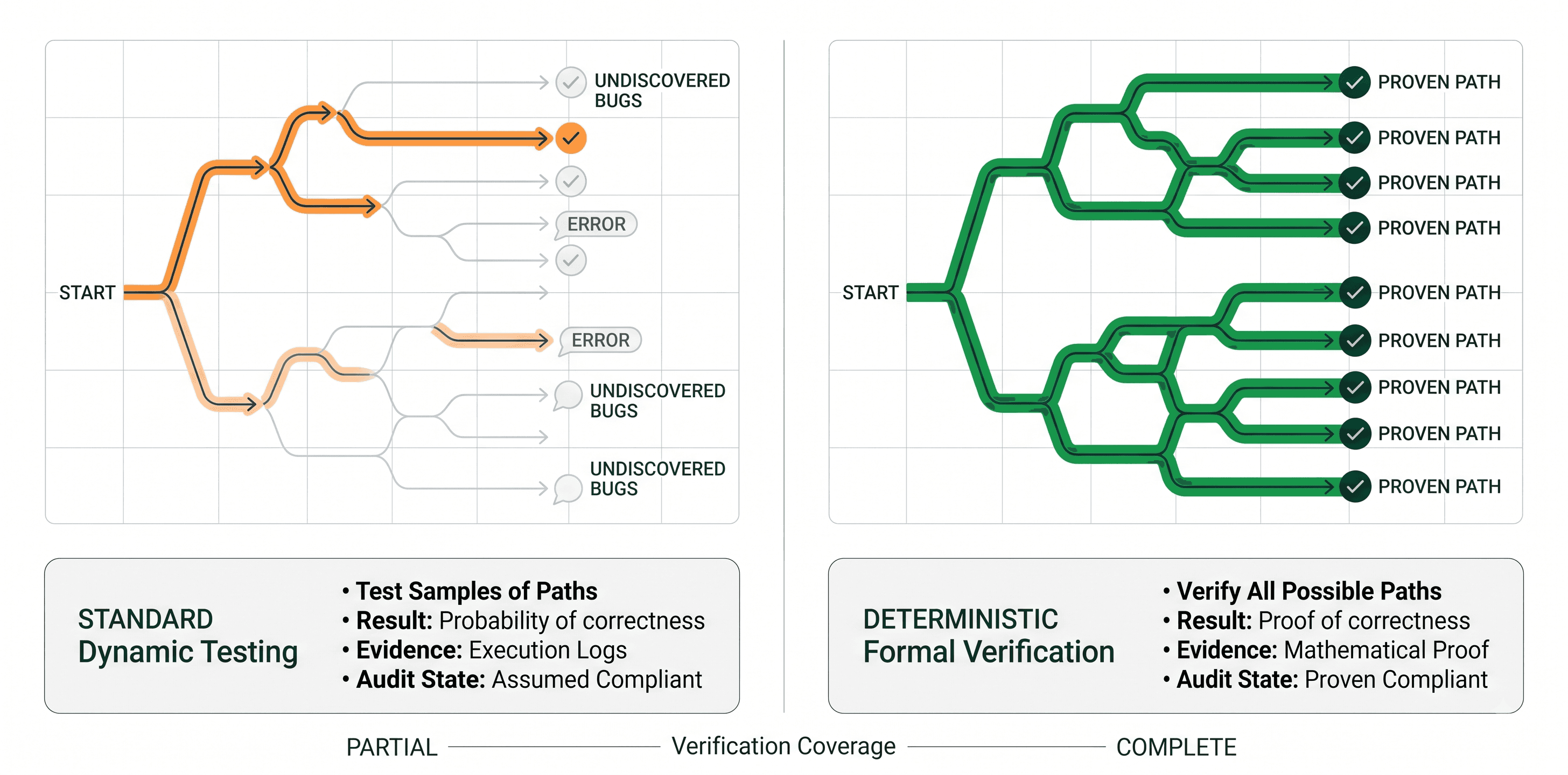
What Deterministic AI Code Modernization Actually Requires: The Semantic Intent Layer
This level of evidence doesn't come from testing harder or running parallel systems longer. It comes from grounding the transformation in something more structured than a prompt, since skipping semantic grounding causes AI systems to hallucinate business logic and create gaps that surface only after deployment. A semantically grounded system reasons against a defined model of what the code actually does, rather than pattern-matching what code typically looks like, which is the difference between deriving intent from the source and guessing at it.
That's the architectural difference between a code translator and a deterministic verification platform. A translator maps syntax to syntax, carrying forward the same ambiguity that made the original code hard to modernize. A semantic intent layer instead reads the source system's actual behavior and derives the target from that, not from a guess at what the original developer meant. Once that layer exists, several things become possible:
Deterministic assurance instead of statistical confidence. Not “99 percent of test suites passed,” but every execution path accounted for, with every artifact dispositioned and zero left unexplained.
Elimination of hidden edge-case liabilities. Discrepancies surface during verification, not after an auditor finds them.
A genuine proof artifact. A line-by-line mapping that documents exactly what changed and why, not a log that only records effort without certainty.
Side effects tracked, not assumed away. The new system is checked against what the legacy system did, with any unmapped state change flagged rather than riding quietly along with a fix.
That last point is what the pilot lacked, where a fix for five known errors introduced an unknown number of new ones. With that evidence in hand, cutover stops being a judgment call under deadline pressure and becomes a checklist instead: every artifact accounted for, every change traced, nothing left unexplained before anyone signs off.
The Evidence Layer Doesn’t Retire at Cutover
Most modernization projects treat the proof artifact as a closing document, generated once and filed away. That's a narrower use of a legacy codebase cutover proof than it needs to be. The same baseline that established what the legacy system did can stay in place after the migration ships, as the reference every future change gets checked against, whether from a developer, an AI assistant, or an autonomous agent.
LLMs propose. Holonic verifies.
That's the same relationship after cutover as during it: a proposed change either matches what's established, conflicts with it, or introduces something genuinely new, and each outcome gets a documented answer rather than a guess. Modernization gets a system in the door on evidence instead of hope. What happens to that system for the years it stays in production, and who answers for every change an AI tool proposes next, is a different conversation, one worth having once the system is live.
See the Proof Artifact in Action
The gap between generated code and production-ready code isn't one better prompting closes, since the issue is a lack of verifiable evidence, not code quality. Teams evaluating modernization vendors can request a live CodeIntent® Studio demo to see what a deterministic proof artifact actually looks like, as distinct from a coverage report presented as one. Customers who move forward run that same verification against their own legacy codebase, the platform's core function.
Share this post
Stay in the loop
Get new writing on deterministic modernization, evidence, and governed AI.
Related articles

How to Detect Unintended Behavior Changes in AI-Generated Code
A one-line code change can alter three business workflows while every test stays green. Here's how to compare behavior against an accepted baseline and make each acceptance decision inspectable.

AI Is Shipping Your Code Faster. What Does It Take to Accept It?
AI can write the code faster than any team can fully account for it. Each accepted change looks fine on its own, but architectural drift, and the understanding debt underneath it, compounds quietly until it doesn't.

Why COBOL to Java Migrations Stall at Sign-Off, and How Bounded Verification Fixes It
AI can generate COBOL to Java migrations fast, but production sign-off still requires a human reviewer's certification. This piece explains why unbounded review breaks down at scale, and how a bounded, source-traced evidence trail makes sign-off possible again.
Sources
Yann LeCun (@ylecun), X/Twitter, March 26, 2023. https://x.com/ylecun/status/1640122342570336267
RepoMod-Bench, 2026. https://arxiv.org/abs/2602.22518
Unwind Data, “The Semantic Layer,” https://unwinddata.com/semantic-layer
HOLONIC
The deterministic evidence layer underneath legacy modernization and the agentic enterprise.
© 2026 Holonic Technologies, Inc. · Atlanta, GA · Tucson, AZ
CodeIntent® is a registered trademark of Holonic Technologies.